
08 Jan RISE UP: #VoicesOfCommunity – Residency for Minoritised Language Artists
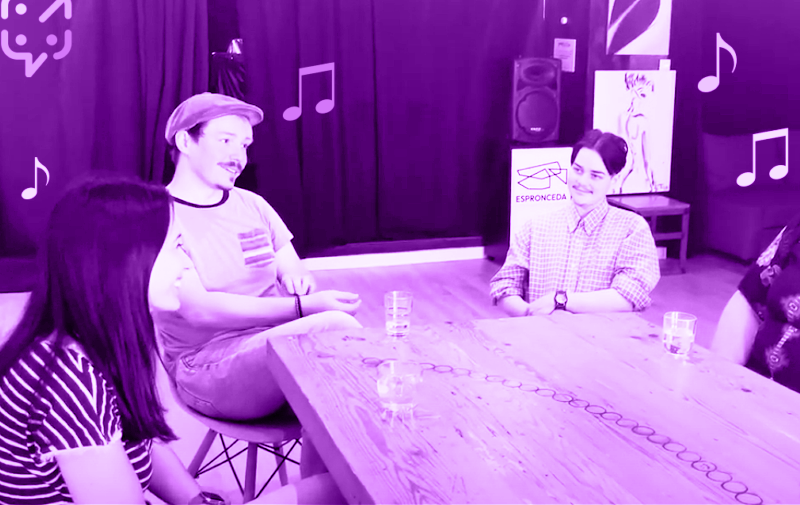
In May 2024, the RISE UP Project invited five minoritised language singers and spoken word poets from all over Europe to an Artist Residency in Barcelona. Together, they explored artistic opportunities, collaborated on an exhibition piece for Sónar+D, and recorded a mixed-language album, which will be made openly accessible on the RISE UP Website. The album features traditional and original songs, poems, folk tales, and prose texts in RISE UP’s five main languages – Aranese, Aromanian/Vlach, Burgenland Croatian, Cornish, and Seto –, allowing listeners to delve into the soundscapes of languages they might not have ever heard before.
In May 2024, RISE UP brought together five artists from various backgrounds in Barcelona with two major aims: 1) connecting members of different minoritised language communities, so they could exchange experiences, knowledge, and plans for the future, and 2) recording their voices, so they could learn from one another’s artistic traditions and to create a record of what these minoritised languages could sound like on their own and together. This was vital for the RISE UP project as initial research had revealed that very few audio recordings of Aranese, Aromanian/Vlach, Burgenland Croatian, Cornish, and Seto are easily and publicly available, especially alongside additional information on the language communities themselves, and that support for minoritised language artists can be scant.
The participants
The RISE UP #VoicesOfCommunity artists were…
- Marina Cuito (Aranese) – her work at the Catalan Institute of Ornithology inspired the #Voices’ chosen collaborative theme of “birds”. A passionate musician, Marina has a YouTube channel for her Aranese songs, as well as Aranese dubbings of popular music, like Disney ballads. In her application, she explained that “Aranese speakers do everything they can to ensure that the language does not die, and I will always try to contribute with my small grain of sand to help them.”
- Daniela-Carmen Stoica (Aromanian/Vlach) – a full-time professor and Head of the Department of Foreign Languages at the Faculty of Education and Philology at “Fan S. Noli” University of Korçë (UNIKO). Highly multilingually and interculturally attuned, Daniela has a good knowledge of Aromanian and has acted as a cultural ambassador in international research groups and organisations, e.g the Foundation for Endangered Languages.
- Mario Csenar (Burgenland Croatian) – a medical expert by training and vocation, he has also been encouraged by his artistic family to write poems and songs from a young age. He feels both the privilege and the responsibility of keeping the rich cultural heritage of Burgenland Croatian alive and wrote in his application that “finding what unites us in a world that, at times, feels like it’s drifting apart is indeed a challenge”.
- Fiona O’Cleirigh (Cornish) – having worked as a journalist in London for almost 20 years, she now lives in west Cornwall and is a bard of the Cornish Gorsedh. She has written creatively for many Cornish projects, e.g. the Ordinalia and the award-winning Stations of the Cross Lanust. In her application, she wrote that “We are not gate keepers, but we should run happily through the gates, hoping that others, those from our land and those who take an interest, will join us.”
- Brett Hiiob (Seto) – about to move on to a Master’s programme in Traditional Estonian Music, Brett has just concluded his Bachelor’s degree with a final concert consisting of traditional Seto music, instrumental pieces and folksongs. In his application, he wrote that “old folksongs carry a lot of knowledge. Physical objects tell a story about how people used to live, but older Seto runo-type songs tell us what people were thinking, what they believed in and what they valued.”
The programme
To immerse themselves in the atmosphere of Barcelona, the artists visited the Art Centre Artesà Tradicionàrius, and enjoyed food, drink, and traditional music, specifically a “Germans Martorell” concert during the concert cycle “La taverna del CAT”. Supported by musicologist and local artist Maika Casalí Masó (ESPRONCEDA), the Voices then spent one week on creating a collaborative art piece (“Woodpeckers”), as well as individual new creations centred on the theme of birds and birdsong. These creations were recorded at Eurecat recording studio and are now freely available on YouTube and the RISE UP Project Website under the CC BY-NC SA 4.0 Creative Commons License (https://creativecommons.org/licenses/by-nc-sa/4.0/deed.en).
Their artistic explorations were supplemented by cultural reflections on important words in their respective communities, which were then also recorded by digital artists Ferran Belda, resulting in a digital art piece called KIELI. Meant to reflect the melding and interplay between languages at community borders, the interactive piece was set up and presented at Sónar+D, a three-day congress on Creativity, Technology, and Business accompanying the annual Barcelona-based music festival Sónar. This made it possible for a wide mainstream audience to learn more about these communities and minoritised language communities in Europe in general.
To foster intercultural exchange and collaboration, the artist residency also featured a workshop on networking possibilities for minoritised groups with Sorbian activist Felicia Touvenot from YEN (Youth of European Nationalities), a creative discussion with Aranese musician Alidé Sans (who also recorded a song in Aranese during her time at the Residency), and an excursion to Primavera Pro, an established music industry event linked to the Primavera Sound Festival.
Impact
Apart from the created album and digital art piece, #VoicesOfCommunity also featured strongly on RISE UP’s social media platforms, including a short interview series where the Voices were asked about their languages and language communities. Additionally, Marie Sauer (M&S) and Maika Casalí Masó (ESPRONCEDA) presented their main findings and the ethical guidelines for working with minoritised language artists developed thereof at the “Operationalising Diversity in Creative AI – Data CARE Workshop”, which included the discussion round “REMIX: WHAT is creative? WHERE do we create? HOW is creative value (re)generated?” and the focus group “Operationalizing diversity in Creative AI – Computer scientists with AI ethicists”.
Links
RISE UP Project website: www.riseupproject.eu
RISE UP #VoicesOfCommunity Album on the Website: https://www.riseupproject.eu/voices-of-community/
RISE UP #VoicesOfCommunity Album on YouTube: https://www.youtube.com/watch?v=HnkXdwrf3Og&list=PLFkbEJA5k2YzGl1khMGPEDaVk2oB7gBOd
Keywords
Minoritised language communities, minority, endangered languages, language revitalisation, digital language activism, minoritised language art, minority language art, artist, artist residency, Aranese, Aromanian/Vlach, Burgenland Croatian, Cornish, Seto, album, singer, spoken word poetry, poet